

As additional GLP-1 drugs become available, they can begin to appear to be interchangeable. However, there are some significant distinctions in their methods of operation and the outcomes they produce.
Although GLP-1s have been around for more than ten years, their growth has recently exploded. Furthermore, despite their seeming similarity, tirzepatide, semaglutide, and liraglutide each have advantages and drawbacks. Consider the case of Wegovy vs. Mounjaro. Are they both GLP-1s? Indeed. Do they differ from one another in any significant ways? Of course.
Although the optimal GLP-1 for you will be determined by your provider or online weight-loss clinic, information is power. Here are the essential facts of Wegovy vs. Mounjaro.
What is Wegovy?
The FDA-approved GLP-1 semaglutide for weight loss is marketed under the name Wegovy. Additionally, this FDA-approved medication for type 2 diabetes is prescribed under the brand name Ozempic.
Semaglutide works by imitating GLP-1, a hormone that your body naturally produces to help control hunger, promote feelings of fullness, and slow down the rate at which your stomach empties. Philadelphia-based obesity specialist Dr. Charlie Seltzer, M.D., claims that GLP-1 has strong appetite-suppressing effects in the brain that are sufficient to result in noticeable weight loss.
What is Mounjaro?
Mounjaro, a brand name for the FDA-approved medication tirzepatide, is also a GLP-1. It is used to treat type 2 diabetes. The FDA-approved weight-loss medication tirzepatide is marketed under the name Zepbound.
Mounjaro’s GLP-1 is combined with a GIP, or glucose-dependent insulinotropic polypeptide, another naturally occurring hormone that is made in the stomach, in contrast to Wegovy for weight loss. That combination helps Mounjaro a little. “When used in conjunction with GLP-1, it enhances appetite suppressive effects and helps to increase insulin to manage blood sugar,” explains Dr. Robert Kushner, M.D., a professor of medicine and medical education at Northwestern University Feinberg School of Medicine in Chicago.
Are generic versions of Wegovy and Mounjaro available?
Wegovy and Mounjaro do not currently have generic versions. This may be a factor in their comparatively high cost (generic medications are frequently offered at significantly cheaper costs than their name-brand counterparts).
Important distinctions between Mounjaro and Wegovy
Beyond their FDA-approved uses and active ingredients, Mounjaro and Wegovy differ most significantly in that Mounjaro has GIP in addition to GLP-1.
For example, Seltzer states, “We know that the GIP makes the GLP-1 work better by suppressing your appetite more than GLP-1 alone.” Furthermore, GIP performs specific bodily functions, including: According to Dr. Holly Lofton, M.D., a professor of medicine and surgery at NYU Grossman School of Medicine and the director of the medical Weight Management Program at NYU Langone Health in New York City, “the GIP targets white adipose tissue, which is an inflammatory type of fat.”
This can enhance white adipose tissue function, which in turn helps with blood sugar and lipid levels.
Wegovy vs Mounjaro employs
Mounjaro is approved for those with type 2 diabetes as a blood sugar management medication, whereas Wegovy treats obesity. According to Lofton, Wegovy is also approved by the FDA for adults who have experienced a prior cardiac event because it may help prevent them from having another heart attack or stroke. Despite not yet having another approval, Mounjaro has demonstrated promise in treating cardiovascular disease.
Wegovy vs. Mounjaro doses and administration
Regarding how to take the medication and how much is in each dose, Wegovy and Mounjaro function rather similarly. According to Kushner, semaglutide and tirzepatide are both started at the lowest dose and are provided as weekly, self-administered injections. This amounts to 0.25 mg for both drugs.
The dosages of both drugs are then progressively raised. According to Kushner, “they are gradually escalated each month to reach the best therapeutic dose, depending on the occurrence of side effects and change in body weight.” (The dose increase for Mounjaro is mostly determined by your blood sugar levels.)
The precise drug you’re taking may affect the final dosage you decide on. Wegovy and Mounjaro have maximum dosages of 2.4 mg and 15 mg, respectively. According to Seltzer, “more people do okay with more moderate doses of semaglutide,” while the majority of people benefit from taking Mounjaro close to the maximum dosage.
Efficiency of Wegovy vs Mounjaro
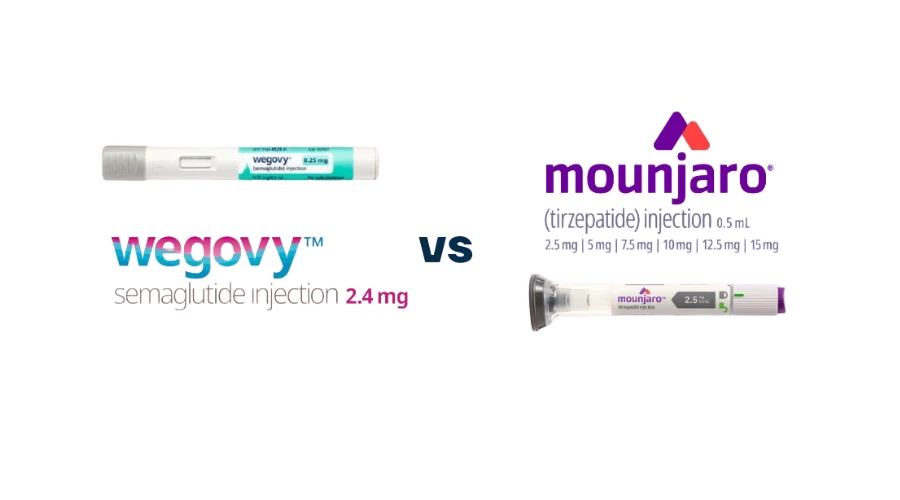
Compared to comparing apples to apples and apples to oranges, this is somewhat redundant. Wegovy’s weight loss results cannot be compared to Mounjaro’s type 2 diabetes results. Kushner states that there haven’t been any “head-to-head” trials between the two treatments as of yet, which would be useful in elucidating their differences.
However, you can compare the medications in each because tirzepatide (found in Mounjaro) and semaglutide (found in Wegovy) both cause weight reduction. Research shows that after 68 weeks, semaglutide causes an average weight loss of 15% of your initial weight, while tirzepatide can cause an average weight loss of 21% after 72 weeks.
The cost and insurance coverage of Wegovy vs Mounjaro
Depending on your specific insurer and plan, GLP-1 drugs used to treat obesity may not currently be covered by insurance providers. Patients must fulfill specific requirements, such as a minimum BMI of 30 (or a BMI of 27 with a weight-related health condition like hypertension), to be eligible for coverage, so even if your insurance plan does cover these kinds of medications, it doesn’t mean you automatically qualify.
But Mounjaro is another matter. Although it ultimately depends on your particular plan, it is approved for the treatment of type 2 diabetes, which is frequently seen as a qualifying illness that may be covered by insurance.
Both drugs often cost well over $1,000 per month at retail without insurance, in part because there aren’t many generic alternatives and because research and development is expensive. It can be beneficial to conduct research and consider all of your options because some businesses, like as Eli Lilly and Company, the company that makes Mounjaro, have savings plans that can help reduce the out-of-pocket expense.
Side effects of Wegovy vs. Mounjaro
Wegovy and Mounjaro have similar side effects, with nausea and constipation being the most common ones relating to the stomach. According to Kushner, the side effects are usually mild and mostly happen during the first four months of treatment when the dosage of the medication is increased.
Mild adverse effects
Due to the slowdown in your digestive tract, the most frequent side effects of both medications are usually mild and include nausea, constipation, vomiting, diarrhea, and abdominal pain.
The side effects of Mounjaro appear to be less severe than those of Wegovy. The addition of GIP is partly to blame for that. In spite of the stomach emptying more slowly, Lofton claims that “dual agonism from GIP provides more of a delay in gastric emptying and has a slight antiemetic effect,” which means that it reduces nausea and vomiting.
Severe adverse effects
Less than 2 percent of people experience major adverse effects from Wegovy and Mounjaro, with the incidence rate of many being less than 1 percent. Among these are pancreatitis, or inflammation of the pancreas; gallbladder problems, like gallstones; low blood sugar; acute kidney injury; hypersensitivity reactions; elevated heart rate; suicidal thoughts or actions; and diabetic retinopathy, or damage to the retina of the eye, a consequence of diabetes. If there are any concerns, your provider can keep an eye out for these conditions. Serious allergic reactions and severe stomach issues are also possible side effects of Mounjaro.
Wegovy vs Mounjaro drug alerts
Because GLP-1s are linked to thyroid C-cell cancers in rats, depending on the dosage and length of treatment, both Wegovy and Mounjaro have black-box warnings — the FDA’s most serious sort — for the risk of thyroid cancer. However, this has not been demonstrated or discovered in humans.
Based on (very uncommon) occurrences from clinical trials, the labels of both drugs additionally include warnings of severe pancreatitis, hypoglycemia (low blood sugar), and acute kidney disease.
Conclusion

Although both Wegovy and Mounjaro are GLP-1 agonists, they differ significantly in a few important ways. Mounjaro is a combined GLP-1 and GIP that is approved for type 2 diabetes, whereas Wegovy is only a GLP-1 and is approved for weight loss. Both of them have the potential to reduce weight, although Mounjaro may lose more than Wegovy. Additionally, they are administered in the same manner—by self-administered weekly injection—and share similar side effects, most of which are gastrointestinal in nature. If you’re unsure which GLP-1 for weight loss is best for you and your needs, speak with your provider or get in touch with one at WeightWatchers Clinic.
For more health realted updates visit www.thepennywize.com
FAQs
Q1. Which is superior, Wegovy or Mounjaro?
Ans: According to the study, Wegovy decreased body weight in obese individuals by over 14%, whereas Mounjaro decreased it by slightly more than 20%. In NHS specialist weight-loss clinics, both medications are used in conjunction with exercise and diet to help people lose weight.
Q2. Is moving from Wegovy to Mounjaro worthwhile?
Ans: Wegovy’s key ingredient, semaglutide, has been shown in a 68-week study to cause weight loss of up to 15%. According to the studies, Mounjaro may be more effective in the long run if you’re wondering if it’s worth switching medications.
Q3. What is better than Mounjaro?
Ans: Trulicity (dulaglutide), Rybelsus (semaglutide), and Ozempic (semaglutide) are the top Mounjaro substitutes for diabetes. Wegovy (semaglutide), Saxenda (liraglutide), and Zepbound (tirzepatide) are available substitutes for weight loss.
Q4. What makes Mounjaro superior?
Ans: The primary distinction is that semaglutide only acts on one hormone receptor (GLP-1), whereas tirzepatide works on two (GIP and GLP-1). It is believed that tirzepatide’s slightly better weight loss outcomes in clinical trials are due to this dual action.
Q5. How much weight loss is possible on Mounjaro in three months?
Ans: It may take up to 18 months to achieve the desired weight loss outcomes you seek from Mounjaro. After two, three, and four months, you should lose 6%, 9%, and 11% of your body weight, respectively. However, by the 18 months, Mounjaro patients lose about 21% of their body weight.

1 Comment
Comments are closed.