
Regulations governing purchase eligibility, tax exemptions, and product limitations apply to duty-free shopping. Regulations must be followed by travelers to prevent unanticipated import duties upon arrival. Being aware of duty-free regulations guarantees a hassle-free shopping experience and helps save money.
Duty-free shopping is the practice of making purchases without incurring any taxes. International tourists leaving the country after a trip are the main target of duty-free shops in other nations. They are primarily found at border crossings, seaports, and airports. You should be aware of the duty-free shopping regulations that regulate what may be sold and what can be bought tax-free when you shop overseas.
How does shopping at duty-free stores operate?
Duty-free shops in seaports and airports are only open to foreign visitors. To confirm your eligibility, your boarding pass must be scanned at the registration desk. This is required by law to stop local airport employees from making transactions. When you arrive in your country, you could be required to pay import taxes on the duty-free items.
7 Rules For Shopping At The Airport
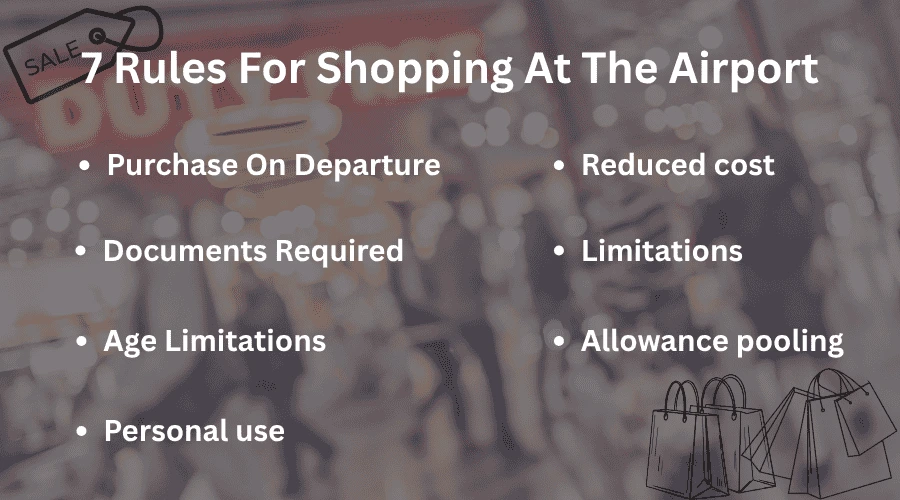
Duty-free shopping regulations typically vary from one nation to another. Seven general duty-free rules and regulations will be examined:
- Purchase on departure: Only departing travelers are permitted to engage in duty-free shopping. The products need to be removed from the country of purchase.
- Reduced cost: Because duty-free stores do not charge taxes, their products are less expensive. Make an informed choice, though, as prices differ between nations.
- Documents required: To shop at duty-free stores, one must show their passport and boarding permit.
- Limitations: The quantity of duty-free goods that can be imported into a country without incurring import taxes varies depending on the legislation of that country. Therefore, be careful not to go above the limit.
- Allowance pooling: It is not possible to combine the funds from two or more passports to make a transaction.
- Age limitations: There are age restrictions on the purchasing of some duty-free goods, such as alcohol and tobacco products.
- Personal use: According to duty-free laws, products must be bought for one’s use only, not for business purposes. All duty-free items must be declared when you arrive at the airport.
Conclusion
To avoid paying taxes upon arrival, foreign visitors should be aware of the duty-free shopping regulations and limitations in both their departure and destination countries. You can save a lot of money by being aware of the rules.
To guarantee a stress-free journey, purchase travel insurance if you intend to travel overseas. It will cover lost luggage, medical crises, and travel cancellations, among other things. For a single trip, you can also buy single-trip travel insurance.
FAQs
Q1. For whom is duty-free purchasing available?
Ans: Duty-free shops in seaports and airports are only open to foreign visitors. To confirm your eligibility, your boarding pass must be scanned at the registration desk. This is required by law to stop local airport employees from making transactions.
Q2. Is it possible to shop via airport security?
Ans: Anything you purchase after security clearance can be brought on the plane for the majority of locations. This includes cosmetics, fragrances, and beverages in bottles larger than 100 milliliters.
Q3. What is the tip for shopping bags at the airport?
Ans: The basic idea of the hack is to carry all of the excess stuff that won’t fit in your hand luggage in an airport shopping bag that you pick up after passing security. Duty-free bags are a way to “game” the system into allowing you to bring extra luggage because they don’t count against your baggage allowance.
Q4. What is the airport’s one-bag policy?
Ans: Each traveler is permitted one handbag up to 7 kilograms and 115 cm (L+W+H). Additionally, one personal item that weighs no more than three kilograms, such as a laptop or a compact bag for women.
Q5. Are lipsticks considered to be liquids?
Ans: Please be aware that stick deodorants, lip balms, and lipsticks are not considered liquids and should not be placed in your transparent plastic bag.